Showing posts with label Formal Observation. Show all posts

Thursday, April 25, 2019

Landforms (Formal Observation)

I spent two weeks learning ALL about Landforms and we had a BLAST! My students were full of knowledge by the end of the two weeks and they were eager for more!! 
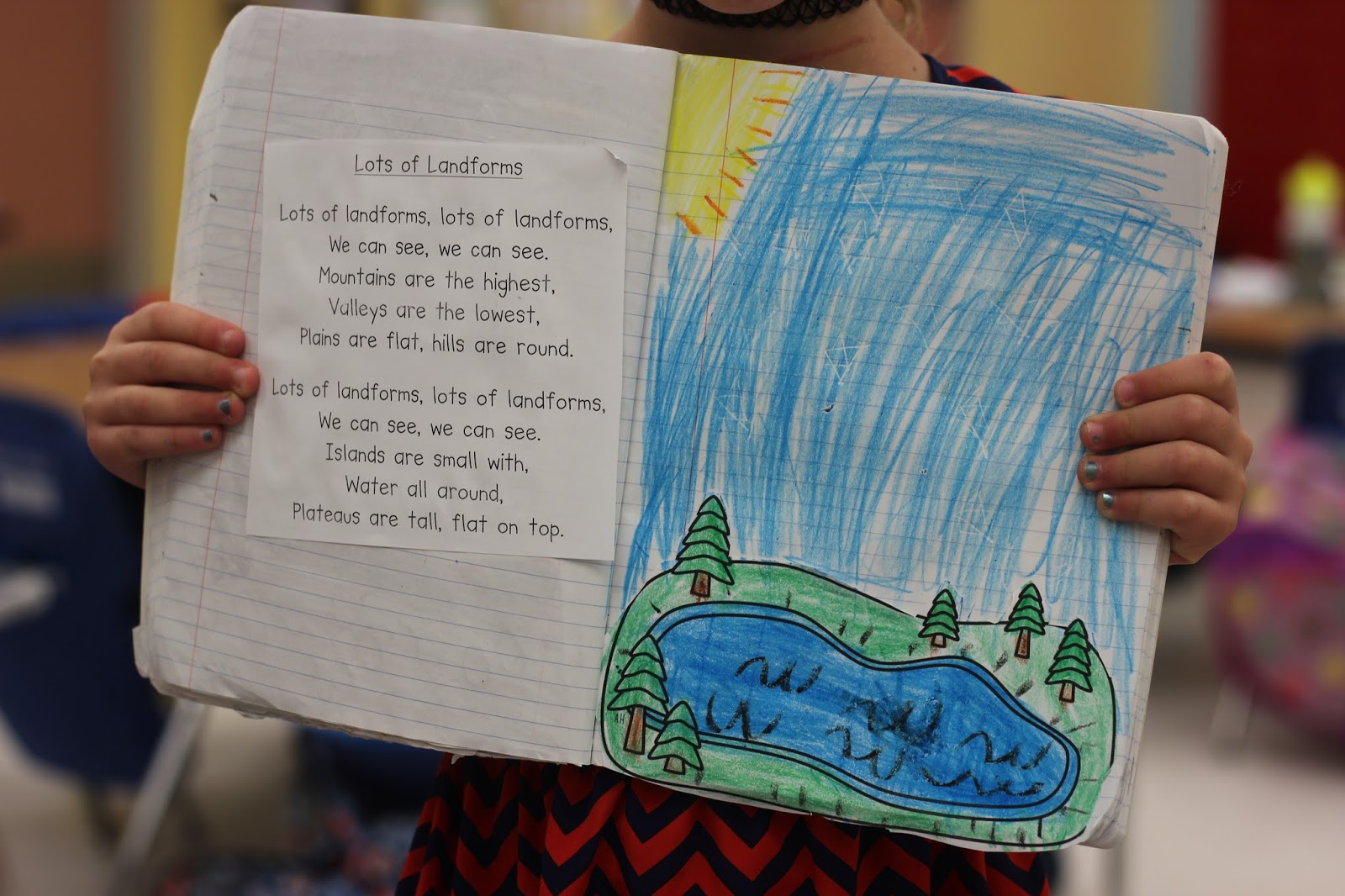
I added a landform poem into my Poetry pack.  We made hand movements for the different landforms (ex. for mountains we put our arms up into a point, for hills we put our arms up but made sure they were rounded).
When we were ready to add the poems into our notebooks I let the children choose which landform image they wanted.  Most students chose their favorite one they learned about which was fun!
So, how did I teach this unit? Every day we learned two different landforms. I gathered books and YouTube videos to help me teach.  After we read a book/watched a video I had students raise their hands and tell me some items that they learned.  We made a T-Chart on our whiteboard full of facts on the two different landforms from that day.
Then I sent the children back to their seats.  I have four tables in my room. I gave each table a piece of paper and assigned them a landform (we did this daily- so on the first day I taught volcanos and mountains, two tables had to make a poster on volcanos and two tables made a poster on mountains).  
They had to work together to add a title, facts, and an image.  They had free range to any art materials in our room. They just had to ask and I would take it out for them!
I've done so many collaborative activities throughout the year that my students are pros on assigning each other jobs and taking on different responsibilities.  For instance, someone made the title and another colored it in.  They took turns making the lines for the facts and writing them. They even took turns cutting, painting, or drawing the landform images. 
As the groups finished making their poster daily, they would present it. We made sure they had a title, facts, and an image and if they did, we would applaud and celebrate the group.
The landforms we learned were:
Monday- Volcanos/Mountains
Tuesday-Oceans/Lakes
Wednesday-Waterfall/River
Thursday-Desert /Hill
Friday- Review day
Week 2:
Monday-Valley/Plateau
Tuesday-Island/Peninsula
Wednesday-Plain/Canyon
Thursday-Landforms wrap up (formal observation)
Friday- Build landforms at our sand park/landform cooking activity 
The first day they made their posters they needed a lot more assistance.  I offered some ideas on how to create the image and I helped them a little bit on assigning each other jobs. 
But, as the two weeks progressed they were so excited to get started and they didn't need me at all!! You can see the group in the image above even asked if they could go outside to get sand from our park to use in their desert! LOVE it!
These looked amazing hanging in my room! I hung them all up on our clothesline. 
Some of the books and YouTube videos that I used can be found by clicking on the links below (there were some days that I didn't have THAT much info, but we got by!) Also, there is a great landform rap on Flocabulary if you have an account and a great book to start off the unit with HERE:
Volcanos: Book 1 or Book 2 and Video
Mountains: Book and Book 2 and Video
OceansBook 
LakesBook 
WaterfallBook and Video
RiverBook and Video (diff bodies of water)
DesertBook and Video
Hill: Book
ValleyBook and Video
PlateauBook and Video
IslandBook and Book 
PeninsulaBook and I didn't find a great informational video but I did show them this as an example
PlainBook and Video
CanyonBook and Video
Then it was time for my formal observation! (This observation follows the same guidelines I've posted about before, just a different topic and activity. You can read more detail in that post.) At this point we had already learned about 14 different types of landforms! To start off the lesson I asked my students how they felt about their knowledge on landforms.  I have a scale on my whiteboard that we use during non-fiction units--it is a scale from 0-4, 0 being I don't feel like I am doing well and 4 being I am an expert and can even help a friend! Most of my students said they were at a 3 so I said to them, let's try to get to a 4 today! I think we can do it!
We went over the directions of the lesson as a class and I reminded them of the rules we use doing cooperative work. Then we made a quick rubric together (ex. everyones project will have a title, a picture, be colored, and at least 4 facts)
I paired the students up into groups of 2 or 3 and called each group up to choose a landform.  
They secretly chose one by reaching their hand into a bucket and pulling one out--they weren't allowed to show anyone! So they took their little piece of paper with them and got to work on their landform riddle! 
I had the white paper pre-folded as you can see above. The students wrote their landform underneath the flap and then kept the paper folded so no one would be able to see the title OR the picture! (When the paper is folded down all you can see are the 4 clues and the question.)
When each group was finished, we gathered at the carpet. We quickly went over the presentation rules (listen attentively, celebrate other groups, etc). I called one group at a time to stand up and present. They read their clues and then had to call on classmates to try and guess what landform they were referring to.  The kids LOVED this!
I mean look at this independent work! I was so proud! I could also tell my principal was beyond impressed. He was taking a ton of photos!
Then I told my students I was going to make sure they knew their landforms on their own by giving them one more activity sheet challenge! My students all had a huge smile on their face when I told them it was a 'challenge'. They love impressing me and knew they could do this! 
They all completed their activity sheet independently and all got a 100%! We went back to our learning scale and did another status check to see where they felt they were now. The whole class said they were at a '4' and I totally agreed! 
This lesson went a little over the allotted time for our observation so my principal didn't see that final challenge or the reference back to the learning scale, but that is okay!! Things don't always go perfectly and I know he saw enough to be happy :)

You can grab the formal observation activities HERE.
SaveSaveSaveSave

Saturday, November 9, 2013

Formal Observation

I had my formal observation on Friday and I am so glad to be done with it!! Hopefully it went well enough that I won't need another :)

I wanted to share my lesson with you because I absolutely loved it and the kids did SO well with it! We use Marzano for our observations, and this lesson was designed with that in mind--lots of Marzano tallies! ;)

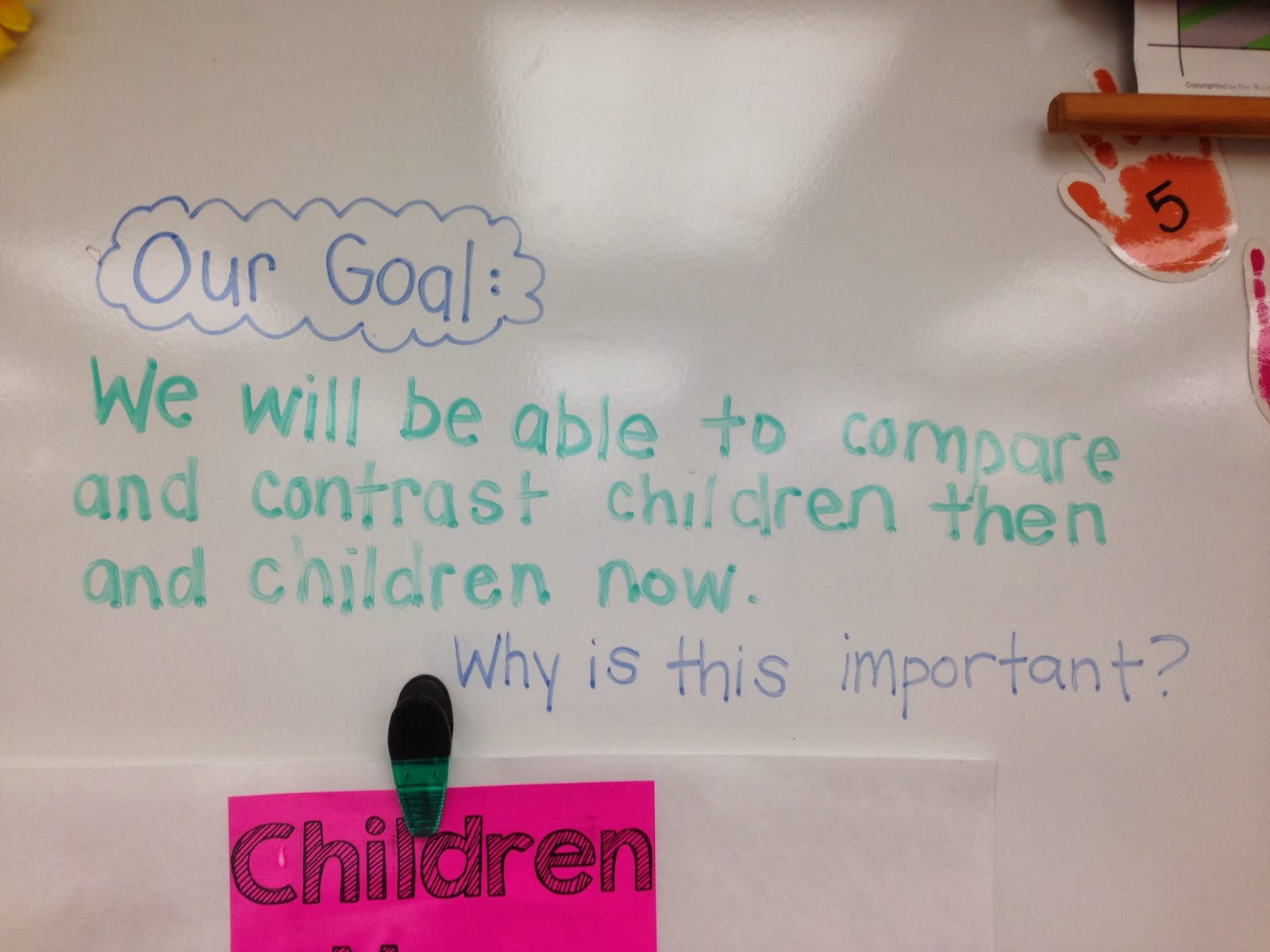
My formal observation was on Friday, but I started teaching about children now/children then on Monday. We always start by going over our learning goal. The learning goal correlates to one of our social studies standards.
 Then we discuss where they feel they are on the learning scale. When I say 'status check' the children reply with 'status check' and then they hold up their hand-displaying a zero, one, two, three, or four depending on where they think they are on the scale. You can find my learning scale HERE for free. As you can see below, on Monday 17 students felt as if they were at a two and three students felt as if they were at a one when it comes to comparing/contrasting children now/then.
 Throughout the week we read Sarah Morton's Day and Samuel Eaton's Day. I only read a couple of pages a day. As I finish reading, I have children turn to their buddy on the carpet. I clap my hands twice and say 'teach'. They clap their hands twice and say 'okay!' When they turn to their buddy they discuss anything new that they have learned. When they are finished I call on different buddies to share what they discussed. I wrote down their new learning onto a post it note and give it to them to 'splash' onto our anchor charts. Here is what our anchor charts looked like by Thursday.
On Monday we also 'splashed' on our new vocab words for the week. Everyday before reading I remind my students of the words and tell them to put their thumb up if they hear a word during reading. If they hear a word we move it over the the left side of the Word Splash and we discuss the meaning. (I don't like to put pictures on the vocab cards because I want students to figure out the meaning.)

Now fast forward to Friday ;)

Friday morning my observation was at 8:15. Before it began I quickly went over the learning scale and reminded students that today was the day we were going to do another 'status check' to see if they moved up on the scale!  I had the children come up with their own goals. They decided that in order for them to hold up a three at the end of the lesson they should know 4 facts. In order for them to hold up a four they should know 6 facts, etc. 
When my observation began I read over the learning goal again. I asked students why that goal was important. They responded with things like, 'the Pilgrims were one of the first to live in America and we also live in America'. Then I reminded them that on Monday 17 students felt they were at a 2 and 3 students at a 1. I told them I can't wait to do a 'status check' today to see if they have gotten better! 
I then said that before we started the lesson for the day I wanted a couple of students to review what we had on our anchor charts. I called on a couple of students to share some differences between children then/children now.
Then I sat down and we went over our carpet rules. You can find these rules HERE. I say 'mirror' and they say 'okay'. As I read the rules, they repeat after me. 
 
I reminded students to listen for a Word Splash word while I read. Then I read one page from the book, If You Were On The Mayflower. The page discussed the chores that Pilgrim children had. (I only read one page because I wanted to make sure I got through the entire observation before my vice principal left!) On the page they heard our vocab word Pilgrim. When they did they put their thumbs up. I paused from reading and had them remind me what Pilgrim meant, then I continued. When I was finished I had children turn to their carpet buddies and discuss whether they learned anything new that was NOT already on our anchor charts. They came up with a couple of things and we quickly talked about it. 
I then told the students that it was time for their challenge! It was time for me to see whether they have met their learning goal!! I explained that I was going to give each group a bag of statements and that group had to decide where it went on the Venn Diagram. 
If you look closely at the photo above, you will see that in the corner of each statement there is a shape. This is so I know what group put the statements on the Venn Diagram in case they put it in the wrong spot. Each group took their bag to their tables. They had to work together to figure out where it went. (Keep in mind...I did this lesson before for practice with bats/birds) Each group had their own tape too. So after everyone agreed they taped their own statements onto the Venn Diagram. At their tables you could hear them reading the statements (one reader in each group), asking each other where they thought the statement went, and finally asking if everyone agreed. If they did, then the 'taper' went and taped it onto the diagram.
These statements are from my November Unit on TPT here.
When everyone was finished they met me back at the carpet. I invited one group at a time to stand up next to me. I read their statements and the rest of the students had to give a thumbs up if they thought the group had placed it correctly and a thumbs down if it was incorrect. We celebrated the groups success and then I called the next group up, etc. 
I really wanted someone to put a statement in the wrong spot so we could have a mini debate, but they got them all right! 
I told them I was so proud of them and then we did our final 'status check'. This time one person felt as if they were at a one, four people at a three, and sixteen students at a four. I then explained to the students that it was okay that 'little Timmy' felt as if he was at a 1 on the scale because 16 students thought they were at a 4! That meant that they knew at least 6 facts AND they could help a friend! So if they can help a friend, they can help 'little Timmy!' 
I then told them that I had an extra challenge for them!!! Since so many students were at a 4 on our scale I wanted them to go back to their groups and write one fact (as a group) that we did NOT put on the Venn diagram. When I gave them their papers some of them were like 'wow this is a challenge' it was so cute! They all got right to work and I went over to 'little Timmy' and asked him a couple questions about children then/now. He answered all of them and I told him that I think he knows more than he realizes and gave him a high-five. 
At this time my vice-principal closed her computer and headed out! She told me it was awesome! HUGE relief!
Believe it or not we did ALL of that in about 40 minutes!

...and I am done! YAY!